Why This Suddenly Matters So Much
Data engineering used to be the quiet, unglamorous layer of the stack. Not anymore.
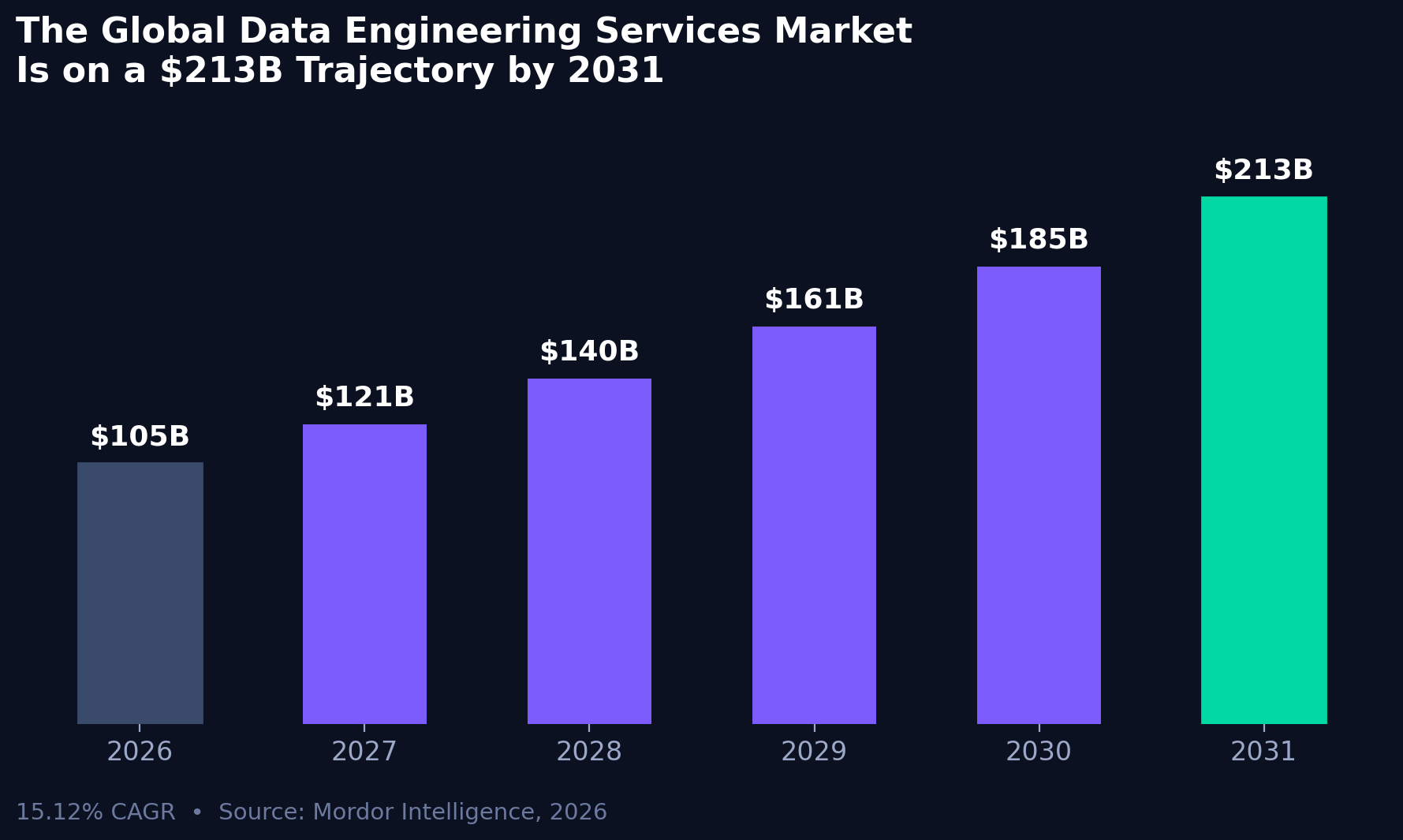
The global data engineering services market hit $105 billion in 2026 and is on pace to hit $213 billion by 2031, a 15% compound annual growth rate that shows no sign of slowing down.
That growth isn't hype. It's a direct response to a very expensive problem: companies are drowning in data they can't actually use.
Every company chasing AI, automation, or "data-driven decision-making" eventually hits the same wall: none of it works without a clean, reliable pipeline feeding it. That's the part nobody posts about on LinkedIn. It's also the part that decides whether your AI investment pays off or quietly disappears into a line item nobody wants to explain in the next board meeting.
Data engineers themselves have become one of the hardest roles to hire for. The field employs over 150,000 professionals globally and added more than 20,000 new jobs in the past year alone. The U.S. Bureau of Labor Statistics projects 36% growth in data-related roles between 2023 and 2033. That’s several times the average growth rate across all occupations.
That kind of demand doesn't happen because a role is trendy. It happens because companies finally realized the plumbing matters as much as the product sitting on top of it.
2. The AI Pilot That Never Left the Sandbox
What we see: A company invests heavily in an AI or ML initiative. It works in the demo. It never makes it to production, or it does, and nobody trusts the output enough to act on it.
Why it happens: AI models are only as good as the data feeding them. Most companies build the model first and discover the data problem second.
What happened industry-wide: This pattern is now the norm, not the exception.
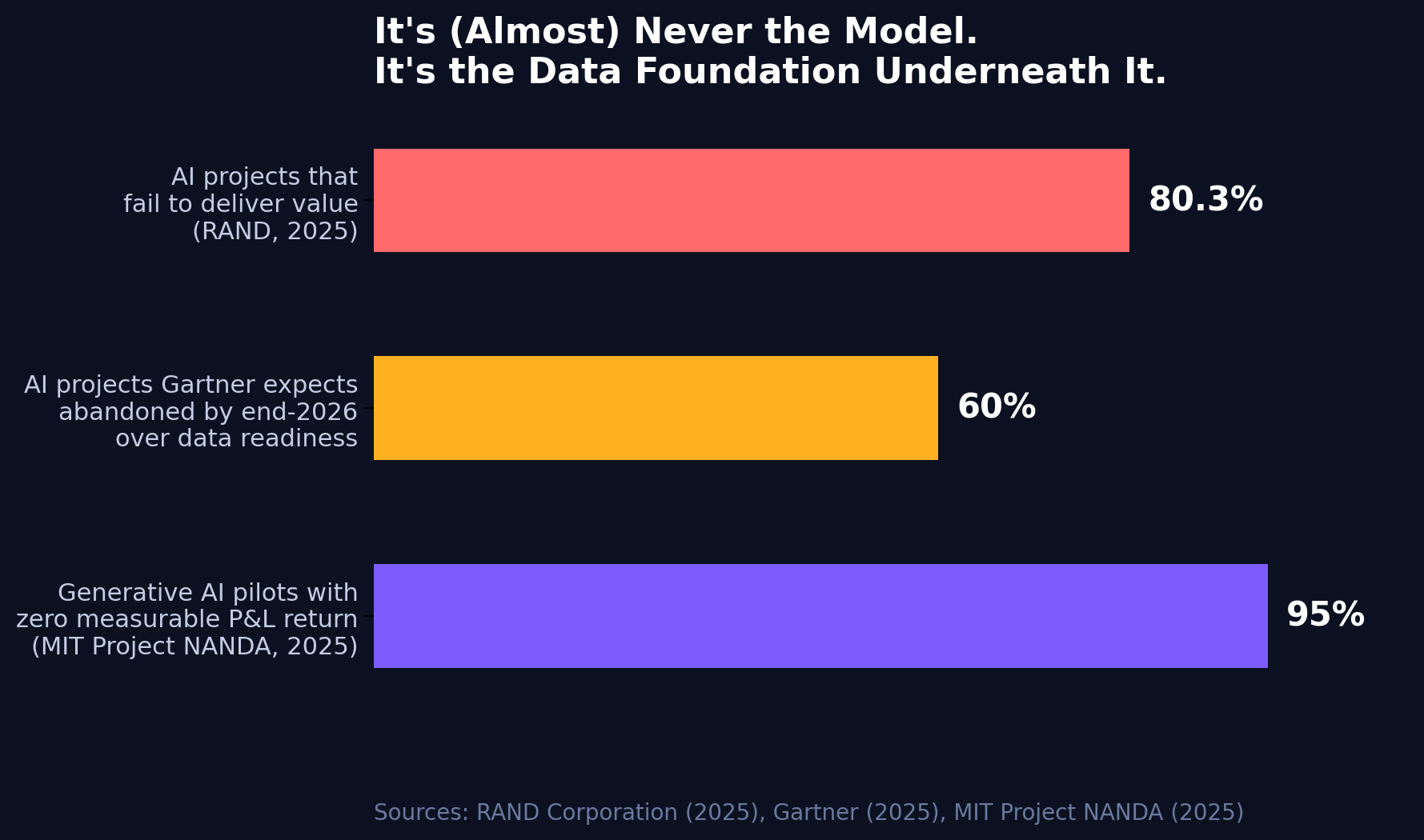
Gartner predicts that through 2026, 60% of AI projects will be abandoned specifically because the underlying data foundation wasn't ready. Not because the model was bad. Because nobody engineered the data layer to support it.
The real learning: If you're budgeting for AI, budget for the data engineering underneath it first. The model is the easy part now. The pipeline is where projects actually live or die.
There's a version of this that stings a little more: Informatica's 2025 CDO survey found that data quality and readiness is now the single biggest obstacle organizations name for AI success, ahead of budget, ahead of talent, ahead of leadership buy-in. Companies aren't stalling because they can't find a good model. They're stalling because nobody engineered the road the model has to drive on.
3. The Legacy System Everyone's Afraid to Touch
What we see: A critical process still runs on an on-prem system from a decade ago. Everyone knows it needs to move. Nobody wants to be the one who breaks it.
Why it happens: Data migrations feel risky because, historically, they have been. One dropped table, one missed dependency, and you've lost records that took years to accumulate.
The fix: A phased migration, audit, map dependencies, migrate in controlled stages, validate at every checkpoint. It turns a high-risk leap into a series of small, reversible steps. This is exactly why our own process for data engineering solutions starts with an audit and ends with ongoing support, not a single big-bang handoff.
The irony is that the longer a company waits, the riskier the eventual migration becomes. Every year a legacy system stays untouched, more business logic gets quietly encoded into it, undocumented, unquestioned, and increasingly load-bearing. Waiting doesn't make the migration safer. It just makes the eventual audit longer.
4. The Pipeline That Only One Person Understands
What we see: A single engineer built the company's ETL pipeline two years ago. They're still the only ones who can fix it when it breaks. Everyone else is afraid to go near it.
Why it happens: Fast, scrappy pipelines get built under deadline pressure and never get documented or handed off properly.
The real cost: Beyond the obvious bus-factor risk, poorly documented pipelines slow down every future integration. Teams spend more time reverse-engineering old logic than building new value.
The fix: Clean architecture with clear documentation isn't a nice-to-have , it's what turns a fragile system into an asset the whole team can build on.
5. The "We'll Deal With It Later" Governance Gap
What we see: A company scales fast, collects data from a dozen new sources, and pushes data governance to "next quarter", every quarter, for two years straight.
Why it happens: Governance doesn't feel urgent until the moment it's very, very urgent, a compliance audit, a breach, a regulator asking questions nobody can answer.
The real learning: Access controls, quality checks, and data lineage aren't red tape. They're the difference between a company that can answer hard questions about its own data and one that finds out the hard way it can't.
The Framework We Use Before Touching a Single Pipeline
Before we write a line of code for a client, we ask four questions. We call it the Audit-First Rule, and it's saved more projects than any tool we've ever bought:
- Where does the data actually come from? Not the org chart version. The real version, with the three spreadsheets and the API nobody documented.
- Who touches it, and when does it break? Every pipeline has a weak link. Find it before it finds you at 2am.
- What decision is this data supposed to support? If nobody can answer this, you're building infrastructure for infrastructure's sake.
- What happens when it fails? Not if. When.
If a client can't answer these four questions about their current setup, that's not a failure on their end, that's exactly the gap our data analytics engineering services exist to close.
Five Patterns We See Constantly (and What They Cost)
1. The Dashboard Everyone Distrusts
What we see: A company has a beautiful BI dashboard. Nobody uses it to make real decisions. Instead, three different teams keep their own spreadsheet "just to be safe."
Why it happens: The dashboard was built on top of data nobody validated. One broken join, one duplicate record, and trust evaporates. And once trust is gone, it doesn't come back just because you fixed the bug.
The real cost: Gartner puts the average financial impact of poor data quality at $12.9 million per year, and some estimates run as high as $15 million. That's not a rounding error. That's often more than the cost of doing the data engineering right in the first place.
The fix: Rebuild trust at the source, not the surface. Data governance and validation checks upstream matter more than a prettier chart downstream. We've watched companies commission a full redesign of a dashboard, spend weeks on new charts and filters, and still land right back where they started, because the underlying tables still had the same silent errors. The dashboard was never the problem. It was just where the problem finally became visible.
What These Patterns Have in Common
Look across all five, and one thing becomes obvious: almost none of these are technology problems. They're sequencing problems.
Companies build the dashboard before validating the data. They build the AI model before engineering the pipeline. They migrate systems without mapping dependencies first. In every case, the fix isn't a smarter tool, it's doing the unglamorous groundwork in the right order.
That's the entire philosophy behind how we approach data engineering services and solutions at 7 Kings Code. Not flashy. Not rushed. Just methodical, in an order that actually holds up under real business pressure.
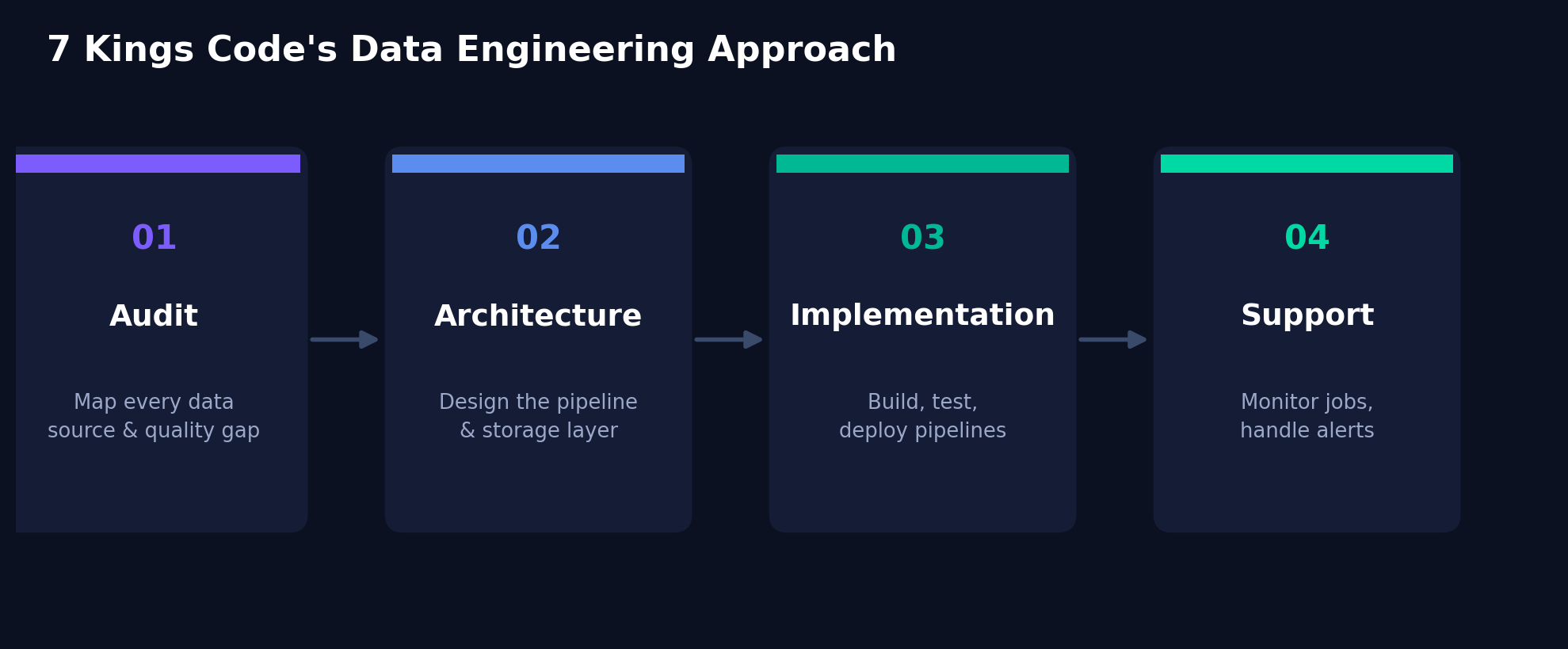
- Audit comes first because you can't architect around problems you haven't found yet.
- Architecture comes before a single line of pipeline code, because retrofitting scale onto a system built for a smaller company is where most technical debt is born.
- Implementation is where we build, test, and deploy, not just the first version, but one built to survive contact with real, messy, growing data volume.
- And Support doesn't end at launch, because pipelines don't stay fixed on their own; they need monitoring and someone who picks up the alert before it becomes an outage.
What This Means for Your Team
If any of these five patterns sounded a little too familiar, you're not behind. You're exactly where most growing companies are right now, sitting on more data than your current infrastructure was built to handle.
The good news: none of this requires ripping out what you already have and starting over. It requires an honest audit, an architecture that matches where you're actually headed (not where you were two years ago), and a partner who sticks around after launch instead of disappearing the moment the pipeline goes live.
We'd also push back gently on one assumption we hear a lot: that fixing this is only worth it once you're "big enough" to justify it. In practice, the earlier a growing company invests in real data engineering services, the cheaper the fix is and the less technical debt it has to unwind later. Waiting until the dashboards are unusable or the AI pilot has already stalled just means paying more, later, under more pressure.
That's what our Data Engineering services are built around data warehousing, ETL/ELT pipelines, data migration, governance, and real-time analytics, backed by a process that starts with your actual data, not a generic template.
Let's Look at Your Data Together
We're not going to pretend every pipeline problem has a one-size-fits-all fix, it doesn't, and anyone who tells you otherwise hasn't actually built one. But we've seen enough of these five patterns across enough industries to know where to start looking.
If your dashboards feel more like a guessing game than a decision-making tool, let's talk to the data team and find out what's really going on underneath them.