What does a data engineer do?
A data engineer designs the technical foundation that allows an organization to use data consistently. Data may come from applications, websites, payment systems, sensors, customer-support tools, or external providers. These sources often use different formats and update at different times. A data engineer builds the processes that bring them together.
Typical responsibilities include creating data pipelines, integrating sources, designing databases and data warehouses, transforming raw data into usable tables, monitoring data jobs, improving system performance, and managing access and security. The work may involve batch processing, where data moves on a schedule, or streaming, where information is processed as it is generated.
Data engineers also care about reliability. A pipeline that works once is not enough. It should continue to work when data volume grows, a source changes its format, a job fails, or another team needs access. Engineers add tests, alerts, documentation, and recovery processes so that downstream users can depend on the data.
Their deliverables might include a cloud data warehouse, an automated extraction and transformation process, a cleaned customer dataset, data-quality checks, a real-time event pipeline, or a documented data architecture. The central question is usually: Can the right data reach the right place in a reliable, secure, and efficient form?
What does a data scientist do?
A data scientist works with data to answer business or research questions. They may investigate why customers leave, estimate future demand, identify unusual transactions, recommend products, measure the effect of a campaign, or predict which cases require attention.
The work usually begins with problem definition and exploration. A data scientist examines the available data, checks its quality, looks for relationships, and decides whether it can support the question being asked. They may use descriptive statistics to explain what has happened, statistical inference to test an idea, or machine learning to predict likely outcomes.
Data scientists create features, train and evaluate models, compare approaches, run experiments, and communicate results. They also need to understand the limits of their work. A model can show a strong relationship without proving that one factor caused another. A prediction can be accurate on historical data but fail when customer behavior changes.
Their deliverables may include an analysis report, a forecast, a customer-segmentation method, an experiment design, a recommendation model, a risk score, or a presentation for decision-makers. The central question is usually: What does the data tell us, what may happen next, and what should the organization do with that knowledge?
The main differences:
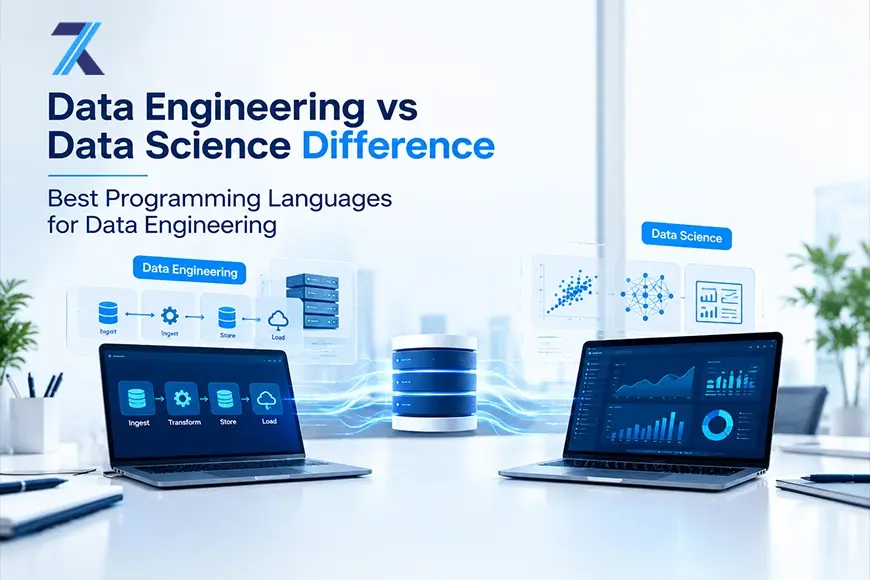
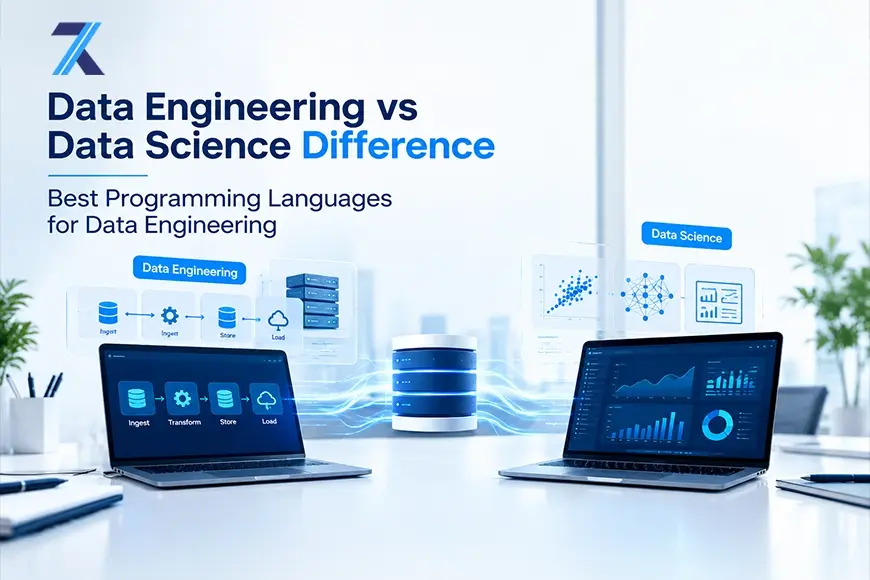
The clearest difference is the direction of the work. Data engineering is generally infrastructure-oriented and works upstream in the data lifecycle. Data science is generally analysis-oriented and works downstream, using prepared data to investigate problems and produce insights.
A data engineer is concerned with scale, availability, performance, data quality, and security. A data scientist is concerned with patterns, uncertainty, model quality, prediction, experimentation, and interpretation. The engineer often produces systems and datasets. The scientist often produces analyses, models, and recommendations.
Their time horizons can differ as well. Engineering work is often continuous because pipelines and platforms need maintenance. Data science projects may be exploratory and iterative, moving from a question to an experiment and then to a model or recommendation. However, a successful model may later require engineering work to operate reliably in a product, which is one reason the boundary becomes less clear in mature teams.
Their success measures also differ. A data engineer may be assessed through pipeline reliability, processing time, data freshness, cost, uptime, and quality-test results. A data scientist may be assessed through model performance, experiment quality, forecast accuracy, business impact, adoption, and the clarity of their recommendations.
Skills and tools used by each role:
Both roles need programming, problem-solving, communication, and a working understanding of data structures. SQL is common to both because engineers use it to manage and transform data, while scientists use it to retrieve and examine data. Python is also used across both fields, although the purpose may differ.
Data engineers typically need strong software-engineering and systems skills. Their toolkit may include SQL databases such as PostgreSQL, NoSQL systems, cloud platforms such as AWS, Azure, or Google Cloud, and distributed-processing technologies such as Apache Spark. Apache Kafka can support event streaming, while Apache Airflow or similar tools can schedule and monitor workflows. They may also work with ETL or ELT tools, infrastructure-as-code, containers, version control, and data-governance systems.
Data scientists typically need stronger foundations in statistics, mathematics, experimental design, and machine learning. Common tools include Python or R, Pandas, NumPy, scikit-learn, TensorFlow, PyTorch, and Jupyter. Visualization tools such as Matplotlib, Seaborn, Tableau, or Power BI help them explain results. A data scientist may also use SQL, cloud notebooks, model-tracking tools, and specialized libraries for natural language or computer vision.
These lists are not strict borders. A data engineer may build a small predictive model to monitor a pipeline. A data scientist may write production code or design a data transformation. The distinction is better understood through the main problem each person is responsible for solving than through a fixed list of software.
How they work together
Consider a retailer that wants to forecast demand for each store. Data engineers may collect transaction history, inventory levels, promotions, holidays, weather information, and store details. They create a consistent pipeline, resolve differences in product identifiers, remove duplicate records, and make the prepared data available in a warehouse or modeling environment.
The data scientist then examines the data and identifies useful variables. They test forecasting methods, compare accuracy, analyze errors, and estimate how the predictions could improve inventory decisions. They explain the trade-offs to the product or operations team.
If the organization decides to use the model, the work continues. Engineers may build a scheduled process that supplies new data, stores predictions, monitors failures, and serves the results to an application or dashboard. The data scientist may monitor model performance and investigate whether accuracy declines as customer behavior changes.
This is not a one-way handoff. Data scientists may find that a crucial field is missing or that timestamps are unreliable. Data engineers may need to change the pipeline so the data is available at the required frequency. Both roles benefit from clear definitions, shared documentation, and early agreement about the business outcome.
Where business intelligence fits
Business intelligence, or BI, is related to both roles but has a different emphasis. BI usually turns current and historical data into dashboards, reports, and accessible performance views. It helps answer questions such as: What were sales last month? Which region is below target? How are support requests changing?
Data science often looks further ahead. It may ask: What is likely to happen next? Which customers are at risk of leaving? What price or action is likely to produce a better result? This is a simplified distinction, because BI can include advanced analysis and data science can describe past performance. Still, BI is commonly associated with descriptive reporting, while data science is more associated with predictive and prescriptive work.
Data engineering supports both. It delivers the reliable data that feeds dashboards and models. In some organizations, analytics engineers sit between engineering and BI, transforming warehouse data into well-defined models that analysts and business users can understand. Smaller companies may combine several of these responsibilities in one role, while larger companies separate them more clearly.
Education and career direction
There is no single required degree for either career, but common educational backgrounds reflect the work involved. Data engineers often come from computer science, software engineering, information systems, or related fields. Their learning usually emphasizes databases, distributed systems, cloud infrastructure, programming, and system design.
Data scientists may come from statistics, applied mathematics, computer science, economics, physics, or formal data science programs. Their training often emphasizes probability, statistical modeling, machine learning, experimentation, and communication. Advanced study can be useful for research-heavy roles, but practical projects and strong technical evidence also matter.
A person who enjoys designing systems, improving reliability, writing production-grade code, and solving performance problems may prefer data engineering. Someone who enjoys open-ended questions, statistical reasoning, experimentation, pattern discovery, and explaining findings may prefer data science. Neither path is universally harder. Engineering often carries demanding operational and scale concerns, while science often involves ambiguity and uncertainty. The better choice depends on the type of problem a person wants to solve.
Common misunderstandings
First, data engineering is not simply database administration. Database knowledge is important, but modern data engineering can include cloud architecture, streaming, orchestration, testing, observability, security, and large-scale processing.
Second, data science is not only machine learning. A strong data scientist may spend substantial time defining a problem, exploring data, designing an experiment, checking bias, or communicating a result. A complex model is not automatically better than a clear analysis.
Third, the roles are not competitors. A reliable data platform does not replace analysis, and a sophisticated model does not fix poor data foundations. The most effective data teams understand the handoffs and involve the right specialists early.
Conclusion
Data engineering and data science answer different questions within the same data lifecycle. Data engineers make data dependable, accessible, and ready for use; data scientists use it to explain behavior, predict outcomes, and support better decisions. Their tools overlap, and smaller teams may combine the roles, but the focus remains different: one builds the foundation and the other extracts meaning from it.
For a business, the practical lesson is to solve the foundation problem before expecting advanced analysis to deliver reliable results. Partnering with experts in Data Engineering ensures your systems are built on solid ground from day one. For an individual, the choice comes down to the work that feels more natural: building resilient systems or investigating uncertain questions. In either case, the strongest results come when engineering and science work as partners rather than as separate departments passing incomplete work from one desk to another.